The group of young novelists I have been working with this year have been working independently. It's been amazing to see their enthusiasm. Yet there is never enough time to give all the attention I would like to each novelist, so I decided to create a series of videos for them. Here is the first one - Setting. This is also my Show Me tutorial.

Stacked in Our Favor
Showing posts with label Storytelling. Show all posts
Showing posts with label Storytelling. Show all posts
Saturday, December 28, 2013


Sunday, June 30, 2013
Consolidating
A couple of years ago I had a plan to separate my content into distinctly themed blogs. I had so many ideas and I dreamed big. It turned out, however, that at the same time I inherited some major projects and my change in responsibilities broadened my focus. At this time, posting all school library and kid lit posts to just one blog makes more sense. I will be closing down Picture Book Inspirations and keeping Purple Glasses Club. A few posts, like the one below, will be migrated to this blog.
Origami Angel (originally posted March 19, 2013 to Picture Book Inspirations)

For years I have been doing origami as part of my story time routine. The kids love and so do I. When I switched schools at the beginning of the school year and met students who I hadn’t seen in years, the first sentence most of them said to me included the word origami.
I wrote an article, Origami as a Teaching Tool in the Elementary Library, a few years back that was published in Library Media Connection in May 2009. It detailed how I use origami in my library program.
With all the push for time on learning I constantly reevaluate what I am doing. For a while I practically cut origami out of my program. After a hiatus I put origami back in…it just made sense. Origami is a great motivator and everything is so much better when students have something to work towards. Still, I started wondering whether I should pre-fold the prizes. Then along came a couple of young boys who totally changed the way I saw the value of origami.
Last Tuesday I was a little discouraged. I needed a little inspiration. I went to pick up my first grade class and a boy handed me a trio of cat puppets.

“See I made these last night. I watched how you made them” he said.
I looked at them in amazement. They were folded almost the same way I folded mine. When I tried to return them, he said “No, those are for you. I have a lot more at home.”
I treasure them.
As if that wasn’t motivation enough for me, later that day I folded a pig puppet for second graders. At the circulation desk a boy told me that he was making pigs at home. His teacher is a great fan of pigs. Another student asked how he learned to do that.
“Oh, I watch Ms. Shoup to learn how. Then I go home and try changing it to make my own things” he said off handedly.
At the beginning of the next day I see his teacher holding an intricate pig mask with an elaborate headdress. The boy was standing beside her pointing up at the mask. There were smiles all around.
The kids are learning all about geometry. Not to worry, I find ways to integrate origami as part of the learning process. I usually make them “pay for” the folds with recalling facts from something we read.
What does this have to do with picture books? When I read a picture book, I try to find an origami that goes with the picture book. The origami is an enticement to sit still, to focus on the story and recall details. The child who wins the origami at the end of class will remember the story as long as they have the prize. This extends the fun far past the moment they leave the room.
It extends mine when I see them clutching their prizes as the leave the school building at the end of the day or hear tales of students who still have them years later.
Saturday, April 24, 2010
Reupholstering an old friend
One of my favorite children has a bunny. A soiled and worn bunny. The child is now a teen and the bunny is now a senior citizen. I’m thinking that the rules that apply to dogs’ ages must also apply to stuffed animals. The time had come for that makeover which was long overdue. I knew the job needed doing last year, but I couldn’t find the right fabric for the job. When the bunny was new, her fur was pink and fuzzy. She had developed a coffee colored patina. One day as I slipped my Land’s End angel fur fleece over my head a light bulb went off. The fleece jacket was so soft and just the right kind of pale pink for the job. I promised myself that I could buy a new one someday. The stuffing coming out of pink bunny’s feet meant that she could wait no longer.

 So the last two weekends I spent giving Pink Bunny a makeover. Why do this? Pink Bunny is a great comfort to her friend. She is also the object of many stories. Stories which are important to not only my young friend, but also to me. Communal storytelling has its own rules.
So on a Friday night I began dismantling Pink Bunny. Carefully I slipped the pointed blades of my German sewing scissors into a seam that was starting to wiggle free. I freed the beginning of a seam and gently opened it to the end. As each piece was detached, I pinned a label onto it as a reference for later. Each label included all information needed “Right leg, right side”. Each piece was then washed by hand to rid it of grime and germs. Though I had planned to iron the pieces, I found that they felted when I did so. In the end, letting them air dry made more sense.
Meanwhile I cut apart my Land’s End sweater and ironed lightweight interfacing to it. It gave it just enough body to make it more manageable. I made patterns of each and every piece (just in case). Then I basted each piece to the new fabric and cut around the edges. It was VERY important that the old Pink Bunny be encased in the new one. Finally, the pieces were sewn together. Sewing through that many layers of fabric was a daunting task for my old sewing machine. The sewing machine had to be cleaned several times. Between the fuzz that shed into the machine during the process and the shear thickness of the pieces, the machine needed a bit of TLC. It took two weeks, but I was able to finish the project. The eyes were a challenge to remove, but easy to restore.

The restored Pink Bunny is much firmer than before. She is soft, solid and no longer soiled. You hear stories of people doing this sort of operation only to have the child reject the item for its lack of authenticity. So with fear and trembling I passed Pink Bunny back to her owner. I need not have feared the rejection, nor the need for the extra stuffing. Pinky is already considerably flatter than when I handed her over. There was a lot of hugging to catch up on.
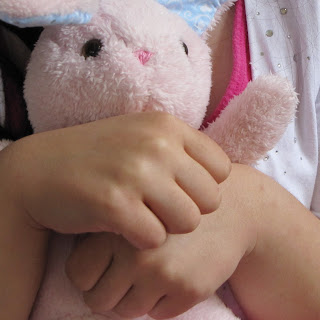
Pink Bunny is ready to star in many more adventures to come. The stories, whether they are written down or spoken into the wind, will continue to amuse and delight.


So on a Friday night I began dismantling Pink Bunny. Carefully I slipped the pointed blades of my German sewing scissors into a seam that was starting to wiggle free. I freed the beginning of a seam and gently opened it to the end. As each piece was detached, I pinned a label onto it as a reference for later. Each label included all information needed “Right leg, right side”. Each piece was then washed by hand to rid it of grime and germs. Though I had planned to iron the pieces, I found that they felted when I did so. In the end, letting them air dry made more sense.
Meanwhile I cut apart my Land’s End sweater and ironed lightweight interfacing to it. It gave it just enough body to make it more manageable. I made patterns of each and every piece (just in case). Then I basted each piece to the new fabric and cut around the edges. It was VERY important that the old Pink Bunny be encased in the new one. Finally, the pieces were sewn together. Sewing through that many layers of fabric was a daunting task for my old sewing machine. The sewing machine had to be cleaned several times. Between the fuzz that shed into the machine during the process and the shear thickness of the pieces, the machine needed a bit of TLC. It took two weeks, but I was able to finish the project. The eyes were a challenge to remove, but easy to restore.

The restored Pink Bunny is much firmer than before. She is soft, solid and no longer soiled. You hear stories of people doing this sort of operation only to have the child reject the item for its lack of authenticity. So with fear and trembling I passed Pink Bunny back to her owner. I need not have feared the rejection, nor the need for the extra stuffing. Pinky is already considerably flatter than when I handed her over. There was a lot of hugging to catch up on.
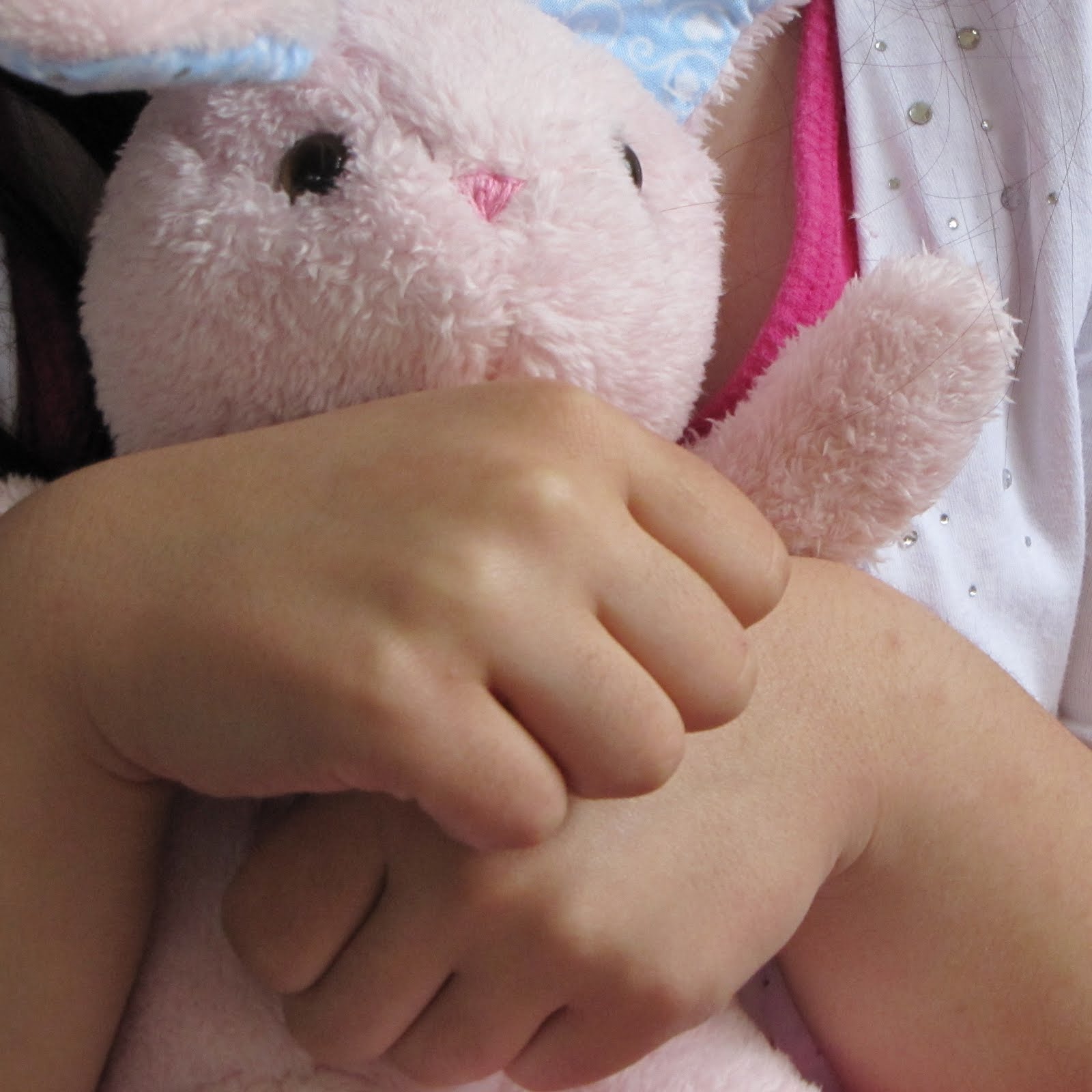
Pink Bunny is ready to star in many more adventures to come. The stories, whether they are written down or spoken into the wind, will continue to amuse and delight.
Tuesday, April 13, 2010
Sharp Scissors
I cut my hand last week. How, you may ask? Well, I was doing a librarian thing. I was telling a story. You see, I find that kids love those fold and cut stories. I devised, quite cleverly if I do say so myself a series of folds and cuts which would tell the story of Cinderella, show her dress in beautiful detail and then fold out to be a crown which could be worn on a child’s head. How clever I thought myself! The paper had to be folded multiple times. Well, just when I was about to unveil the beautiful dress I cut through the paper and into my hand. Having elected to use the “big girl scissors” the slice was clean and swift. I was able to finish off the item before my hand bled too much. Lucky for me, the school nurse is a gem. She showed no hesitation in bandaging me up multiple times that day. The cut was positioned in such a way as to make it near impossible to keep a bandage interested in staying put.
For the rest of the week I had to explain the large bandage or the rubber glove I wore over my liquid bandaid. It kept my wound safe from the inevitable germs which must be braved if you work with little ones who still put their hands in their mouths. So I turned my lesson to one of safety. Worried that the students be afraid of the glove or the wound, we discussed both and took the opportunity to discuss safety issues. I showed them the “big girl scissors” I had used on that fateful day alongside a pair of children’s safety scissors. We compared and contrasted their features. We discussed their safety features. And we voted. Guess which pair they wanted me to use?
Needless to say, I gave up the crown - at least for this week. I also gave up trying to be neat. Now I let the paper fall to the floor and pick it up later. Trying to hold, cut and catch simultaneously is what gave me this wound. So I dreamed up another fold and cut which requires me to cut through just the two layers of paper. As I wanted to read variations on the Cinderella theme, I chose to recreate the slippers. Students identified elements of the original story through prompts. The paper was then cut to produce a shape to represent each element. Finally I asked what Cinderella left behind to help the prince find her. They were delighted to see the paper cut into the glass slipper.

They were even more delighted to see me open the paper to unite the two slippers so that the prince could realize he had found the girl of his dreams. Watching the amazement on their faces was a joy. Even boys who had groaned when they heard we would be reading a variation on the Cinderella theme were jumping up to participate.

Ways to add value to your fold and cut story
1. Don’t worry if each cut doesn’t really graphically represent the story element. The kids don’t really care. If I want to cut a triangular shape I do think about ways I can reflect that in the story or visa versa. Still, students will be anxiously trying to guess what you are cutting. They will be too busy to critique your matching skills.
2. DO NOT try to hold the paper and catch it with one hand. That is how I got my wound. Let it fall to the floor and pick it up later. Better yet, don’t stop the child who is picking it up for you. You can also position a recycling container near your seat if it doesn’t get in the way of the visuals of your storytelling.
3. Tell the children that you will be folding the paper in half. Ask how many times you have to fold to do so. Ask how many sections you will have if you fold in half. Ask what will happen if you cut one side. Introduce/reinforce the word symmetrical. By doing this you will be working on geometry skills. Our kindergarten students know the word symmetrical. Yours can too.
4. Be creative. Sometimes I tell the story. Sometimes I ask questions and make a cut for each answer. In the case of Cinderella, I asked leading questions about the storyline. “Who was the person who helped Cinderella?” We then went on to read other variations on the Cinderella theme. Comparing and contrasting the versions made this more than a simple reading session, though that would have been just fine with me.
5. Use safety scissors. Really do try to avoid bleeding on the prize.
6. If you feel so compelled, you can double up the paper to make two prizes at once. I don’t recommend this for several reasons, but you can if you need to. If there are too many layers you are more likely to cut yourself. I stand as proof. Also, the paper tends to slip a bit and the figures don’t always come out the symmetrical works of art you are looking for. Also, there is magic in winning the prize which is unique and made just for you.
7. Vary your paper color for some fun.
8. Use books to get ideas, but once you have run through the ideas you CAN start to make your own patterns. Really. You can.
9. Do not think that you are wasting time. Children really enjoy these stories. I used them successfully one year. The next year I was so worried about covering other things that I let them go. Students who had them the year before were constantly asking for them. One day I decided to do one and I realized how much they got from them and how to make them value added. In addition when I started doing them after the hiatus, the adults clapped their hands and told me it was their favorite part of library. Anything which makes people really want to come see you adds value.
10. Make it enjoyable.
What was the magic for me? Spring fever has hit. Yet students were on their best behavior hoping to win that piece of paper. That’s the best thing I could ask from any fairy godmother.
For the rest of the week I had to explain the large bandage or the rubber glove I wore over my liquid bandaid. It kept my wound safe from the inevitable germs which must be braved if you work with little ones who still put their hands in their mouths. So I turned my lesson to one of safety. Worried that the students be afraid of the glove or the wound, we discussed both and took the opportunity to discuss safety issues. I showed them the “big girl scissors” I had used on that fateful day alongside a pair of children’s safety scissors. We compared and contrasted their features. We discussed their safety features. And we voted. Guess which pair they wanted me to use?
Needless to say, I gave up the crown - at least for this week. I also gave up trying to be neat. Now I let the paper fall to the floor and pick it up later. Trying to hold, cut and catch simultaneously is what gave me this wound. So I dreamed up another fold and cut which requires me to cut through just the two layers of paper. As I wanted to read variations on the Cinderella theme, I chose to recreate the slippers. Students identified elements of the original story through prompts. The paper was then cut to produce a shape to represent each element. Finally I asked what Cinderella left behind to help the prince find her. They were delighted to see the paper cut into the glass slipper.

They were even more delighted to see me open the paper to unite the two slippers so that the prince could realize he had found the girl of his dreams. Watching the amazement on their faces was a joy. Even boys who had groaned when they heard we would be reading a variation on the Cinderella theme were jumping up to participate.

Ways to add value to your fold and cut story
1. Don’t worry if each cut doesn’t really graphically represent the story element. The kids don’t really care. If I want to cut a triangular shape I do think about ways I can reflect that in the story or visa versa. Still, students will be anxiously trying to guess what you are cutting. They will be too busy to critique your matching skills.
2. DO NOT try to hold the paper and catch it with one hand. That is how I got my wound. Let it fall to the floor and pick it up later. Better yet, don’t stop the child who is picking it up for you. You can also position a recycling container near your seat if it doesn’t get in the way of the visuals of your storytelling.
3. Tell the children that you will be folding the paper in half. Ask how many times you have to fold to do so. Ask how many sections you will have if you fold in half. Ask what will happen if you cut one side. Introduce/reinforce the word symmetrical. By doing this you will be working on geometry skills. Our kindergarten students know the word symmetrical. Yours can too.
4. Be creative. Sometimes I tell the story. Sometimes I ask questions and make a cut for each answer. In the case of Cinderella, I asked leading questions about the storyline. “Who was the person who helped Cinderella?” We then went on to read other variations on the Cinderella theme. Comparing and contrasting the versions made this more than a simple reading session, though that would have been just fine with me.
5. Use safety scissors. Really do try to avoid bleeding on the prize.
6. If you feel so compelled, you can double up the paper to make two prizes at once. I don’t recommend this for several reasons, but you can if you need to. If there are too many layers you are more likely to cut yourself. I stand as proof. Also, the paper tends to slip a bit and the figures don’t always come out the symmetrical works of art you are looking for. Also, there is magic in winning the prize which is unique and made just for you.
7. Vary your paper color for some fun.
8. Use books to get ideas, but once you have run through the ideas you CAN start to make your own patterns. Really. You can.
9. Do not think that you are wasting time. Children really enjoy these stories. I used them successfully one year. The next year I was so worried about covering other things that I let them go. Students who had them the year before were constantly asking for them. One day I decided to do one and I realized how much they got from them and how to make them value added. In addition when I started doing them after the hiatus, the adults clapped their hands and told me it was their favorite part of library. Anything which makes people really want to come see you adds value.
10. Make it enjoyable.
What was the magic for me? Spring fever has hit. Yet students were on their best behavior hoping to win that piece of paper. That’s the best thing I could ask from any fairy godmother.
Subscribe to:
Posts (Atom)