Stacked in Our Favor


Thoughts about libraries, education, children's literature, writing, art and being connected


Showing posts with label Awards. Show all posts

Friday, December 31, 2010

The Kids Vote


Thursday, December 23rd, the last of our kids cast their ballots in the Mock Caldecott Election. The last couple of weeks before our vacation were a whirlwind of activity. Trying to make sure every class had read all the books was challenging enough, but student absences made getting full participation tricky. Every morning I ran around before school with a list of students who had been absent the day their class voted. I was able to round up more than half of the missing students this way.

Well, the voting is in and here are the results:

We had 395 students from grades PreK-1 cast their ballots.
Our selections were:


Title
Illustrator
author
Number of votes
Medal Winner
Art and Max
David Wiesner
David Wiesner
90
Honors
City Dog, Country Frog
Jon Muth
Mo Willems
49

Push Putton
Aliki
Aliki
41

Children Make Terrible Pets
Peter Brown
Peter Brown
35

Bear in the Air
Amy Bates
Susan Meyers
32

At the end of the day, I asked to have the results be announced along with the Caught Being Good announcement. I can’t tell you  what the reaction was elsewhere in the building, but the class that was in the library let out a cheer.

It was a great feeling to come to the end, but it was also sad. I can only imagine how members of the Caldecott Committee feel once the decision has been made and the phone calls made to inform the winners.

What is left for us is awaiting the announcements on January 10th and discussing our thoughts about the process

Tuesday, December 28, 2010

Mock Caldecott Focus Group Voting


On Monday, December 20th the Mock Caldecott Focus Group met to cast their votes. This is the one for adults. There was a bit of nervousness on my part. I had some ideas of how we would start this process, but the rest would have to emerge somewhat organically. People were popping in throughout the day to check books they had not seen or re-familiarize themselves with titles they hadn’t seen in a while.

As soon as my last class had finished I put the books out on display so that they would be easy for everyone to see. The meeting was scheduled for half an hour later, but people started coming, reviewing and discussing almost immediately.

I decided that voting using the method I developed for the student elections would work out well for our adults as well.  Using the Mock Caldecott Medals we made as ballots for the students to vote with we could get a quick assessment of the level of agreement of our members. Originally, I had intended to open it up to discussion and debate before casting the first votes. However, the demands of the holiday, as well as flu, season had people an edge. They came early and discussed generally. When we were all assembled there was an eagerness to get down to business and vote.

I decided to give each member 2 medals. This way we could gather general opinion and equalize some of the quirks each of us harbors. We then removed any book that had received only one vote. This left us with five books to narrow down. Happily, this was the maximum number we could have. All we had to do was vote again to decide which would be the Medal winner and which would remain to be classified as Honor books. Once again each member received 2 medals and were cautioned that they needed to use them for different books. The clear winner was City Dog, Country Frog. This had been a favorite from the beginning. It didn’t loose its charm. In fact, it was one chosen to be in the selection for our student Mock Caldecott. Even reading it 20 times in a week and a half couldn’t sour it. That is the mark of a book that holds together.

Our selections were:


Title
Illustrator
author
Medal Winner
City Dog, Country Frog
Jon Muth
Mo Willems
Honors
In the Wild
Holly Meade
David Elliot

The Boy in the Garden
Allen Say
Allen Say

Henry Aaron’s Dream
Matt Tavares
Matt Tavares

Art and Max
David Wiesner
David Wiesner

Upon reflection, I realized that we had engaged in the discussion before we voted. It’s just that we had been discussing these books all week. Unlike the real Caldecott Committee members, we work together every day. Our thoughts about books are shared pretty much immediately. I hear comments about a book I have just reviewed as I walk down the hall on the way to bus duty. I share a thumbs up with a teacher who drops their class off for library. Students tell me that their teacher has read one of those books to them and that they all love it. I shoot back with my own thoughts and watch as they are absorbed, debated and shot back to remind me about the criteria. It’s kind of like the twitter version of the committee. 

Tuesday, December 21, 2010

Mock Caldecott Voting


Last week, when the first class cast their ballots for the book they thought should win the Caldecott Medal I discovered a few things.

It was interesting to watch. Several boys had discussed their choice before class and spent the time trying to convince everyone to join them in voting for their favorite book. Meanwhile, one boy who came to a decision through much consideration and weighing of qualities convinced a group of girls to vote with him. Listening to these two groups debate the virtues of their choice left me speechless. These kids are 6 years old!

Now I do believe that the power of debate is a great thing, however, we wanted students to feel free to vote for the book they really thought was best. Need I explain peer pressure? Or the desire to be like others? So after the first go round I changed the rules a bit.

The contest we held earlier to create the most faithful representation of the Caldecott Medal yielded a good number of excellent entries. Frankly, it was harder to choose the winner than it was for me to choose the book I wanted to vote for. Finally, however, I applied criteria and found that one stuck out clearly to me.


Before the vote we took a book parade. Students were asked to walk in a path by the books so that they had a chance to look at them and start to think which one they wanted to vote for. Before I did this it took a long time to make decisions. This little parade gave them a chance to
1.    move their bodies before sitting and waiting for everyone to have their turn.
2.    View all the covers again
3.    Start thinking about which one they might like to vote for.

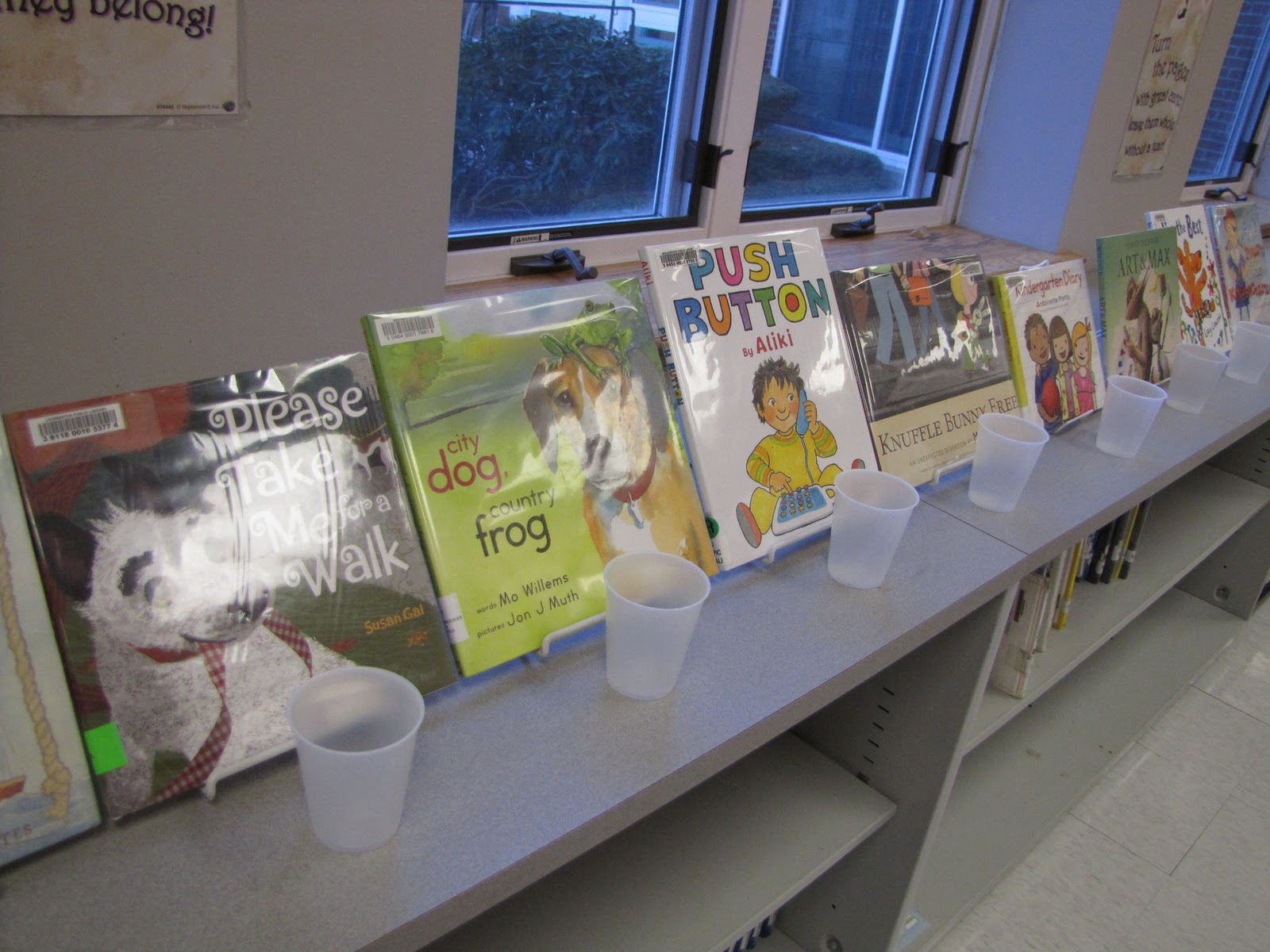
To vote, I called each student and checked their name off my list. They took a medal and had to put it in the plastic cup in front of the book they wished to select. The class faced away from the display of books to give them a modicum of privacy. After every student had voted we tallied the votes. I have been chasing down students who missed class using this list.

Students seemed to enjoy using the medals and it made voting clear and easy to do.

Some students got confused, however, and thought that they couldn’t put their medal in a cup if it already had one in it. It seems so easy to explain a task like this, but for young children who don’t really understand the concept of voting it is very important to explain the process in great detail.

Things I would explain:
1.    We don’t need to touch the books.
2.    You don’t have to put your hand in the cup
3.    Just drop the medal in the cup.
4.    You drop the medal in the cup which is in front of the book you want to vote for.
5.    It is ok if there is already a medal in that cup. You can put yours in there too.
6.    We are voting for the book with the finest illustrations
7.    Illustrations are pictures. (Just in case they have forgotten.)
8.    We are looking toward the front of the room, not at the person voting.
9.    When we give the person privacy to vote, they feel comfortable to choose the one they like. Not the one something they like likes.
This is exciting.

Voting will continue to the end of the week. I can’t wait to see what they choose.

Sunday, November 28, 2010

Mock Caldecott, ambiguity and making decisions


On Monday, the participants in the adult version of the Mock Caldecott will meet to nominate their top three books. A list of these books will be compiled and we will all read these titles. I expect chaos to ensue. In fact, I’m looking forward to it.

Last week people kept saying to me “I’m still looking for THE ONE.” I can sympathize. They want one that blows them over, knocks them over the head and has a label that says “This is the one.” No one wants to be wrong.

This is part of a trend I’ve been seeing for a while. People want to know the right answer. They are afraid of getting it wrong. Standardized testing doesn’t do much to alleviate our fears. We are trained to pick “the right answer” from a group of four possibilities. Frankly, life isn’t much like that. There’s so much more ambiguity.

Just think about it. Making choices in health care is seldom a clear-cut experience. You have to weigh the pros and the cons and make your best guess. Even gathering reams of information won’t help you make a decision that is definitely the correct one. There is room for error. You have to make your best guess based on what you know. It’s a leap of faith.

Our current political and economic environment doesn’t help. There’s plenty of ambiguity facing people in personally significant ways. People who have lost jobs, homes, cars and hard cold cash in the economic downturn must feel the need for answers. There are certainly many, many questions. Finding a silver bullet remains elusive.

Choosing a career, a spouse, a home, even a vacation are all matters of weighing the pros and cons. The career may be the wrong one if a field dries up. Think about people who continued making buggy whips after the motorcar was invented. A spouse can have a mid-life crisis. A hurricane can whip through your vacation paradise. No one can be sure that the decision they are making is the only “right” choice. But we want to feel that there is, out there somewhere, a correct choice to choose.

Life just isn’t that certain.

So participating in an activity that is fraught with ambiguity is at times uncomfortable. Fear of inadequacy, incompetence and failure haunts us.  Sometimes we hope that the right answer is there, that we will somehow miraculously choose it. Then that feeling of discomfort will pass away.

To enjoy the process of the Mock Caldecott you have to let it go. It is much more enjoyable to me to listen to others and learn from them than to think I know the answer. Though it’s not something I’m proud of, I must admit it has taken some effort for me to get to that point. It hasn’t come naturally.

Naturally, I would like to pick the winner. I still remember what it felt like to tell students that I had chosen Jerry Pinkney’s The Lion and the Mouse as my pick for the medal. How glorious it felt to be right. My dear students applauded when they heard the news. They were so proud of me. Will I choose it again this year? Maybe, but maybe not. That’s not the point. This year, I’ve moved beyond that. It is not whether I am “right” or not. It’s really more about the process and who I become through the process. I’ll choose a contender – a really fine book.

I anticipate that there will be participants who come to the meeting on Monday who have not yet made their decisions as well as some who feel confident. No doubt about it, I’m anxious to experience this part of the process.

Am I going to tell you which books I choose? No way. I might be wrong.

Saturday, November 20, 2010

Mock Caldecott for Students

As we were looking at so many great new books, I began to think it made sense to extend the project to our students. Naturally, they can read neither the number nor the range of books we are reading. They can, however, have a limited number read to them, discuss their relative merits and make a decision based on the criteria given to them.

So a couple weeks ago I started going through the selections I had read to pull out the titles I thought age appropriate. Ten books seemed like a reasonable number to have students be able to read and think about. So we are compromising between the many I’d like them to read and what I think optimal and going with 15 books.

Introducing the project to the kids was even more rewarding than I anticipated. They were very excited to have a chance to pretend in school and to have a chance to vote!

We reviewed what the medal is for, who awards it and who receives it, the shape and color of the medal, as well as the various elements of the design on the medal. Kindergarteners who had just learned about the medal last week proved to have impressive memories. First graders who had the lesson last year impressed me with their ability to recall the design elements.

Some people have questioned whether learning the elements on the medal is important. My response is a resounding YES! After students have learned about the Caldecott Medal they are very enthusiastic to find one in the library. In their excitement to find one, children will bring me copies of books with the Pura Belpre Medal, the Geisel Award, the Newbery Medal, Parent’s Choice Awards, The Golden Kite Award and even the spectacularly differently shaped Coretta Scott King Award. It seems as though as long as it glitters it is a Caldecott in their minds. I remind them to think about what is on the Caldecott Medal. Then they are instructed to compare what they are looking at with what they know to be elements of the Caldecott Medal.

I outlined some basic things we were looking for in the illustrations:

-       Do the illustrations match the story?
-       Did the illustrator use the kinds of colors that would make the story more understandable?
-       Did the shapes match the feeling of the story? (Sharp objects being scarier. Round objects being more comfy.)
-       Was the illustrator good at his/her job?

Students did a remarkable job of responding to these questions. They are challenged to evaluate whether they think a book will be happy or sad by looking at the cover. Then they are required to give an explanation.

The adult group found it very difficult to separate their feelings about the story and the illustrations. If the story was heartwarming they overlooked inconsistencies or lack of prowess with the artistic medium.  It took several weeks and plenty of coaching for the process to become more natural.

Interestingly enough children fall into two camps on this skill.

1.     Some students are completely unable to separate their thought about the book based on text, illustrations, theme, etc. One student thought the illustrator had done a very bad job on the book. When I asked why he stated that it was “because the book is sad.” This tendency is not likely to be a surprise as we are used to thinking of children as being less sophisticated than adults.
2.     Some students have little to no trouble separating the illustrations from the text. In fact, they treat them as two separate items. I would postulate that this is because they are used to experiencing books in this way. I am working with very young children who are in the process of learning to read. Some of them have very little ability to read a book on their own. These children primarily experience books by flipping through the pages and “reading” the pictures. Recently when I introduced the “5 finger rule” to a class I saw a student with his 5 fingers up “reading” the book making up his own story as he went. Not so amazingly, all five of his fingers were still up at the end of the book. This is how he envisions the reading experience.

Running the Mock-Caldecott, or the Fake-Caldecott as one student calls it, with students is well worth the effort. Students are really enjoying it and it' interesting to see the experience through a different lens.

Saturday, November 6, 2010

Battle Fatigue - Mock Caldecott Group End of Week Six


A number of events converged to make this an interesting week for our participants. Our district had an in-service day which meant that few of us were in our regular spots. For many of us that meant one less day to get our reviews done.

Many of us have succumbed to the nasty chest cold we are sharing. That didn’t exactly help our ability to review this week’s quota of books.

But most difficult of all was the closing of grades for the semester. Correcting papers, calculating grades and posting them will take priority for the next week. That makes it really tough to stay on top of reviewing for all but the most die-hard children’s lit enthusiasts.

When we started the group people clustered together, sharing their thoughts as they went. Looking for inspiration, validation and ideas. This week I saw a big shift. A number of people sought to do their books in isolation. It seems that some people have gotten beyond the honeymoon stage of uncertainty and the need for approval. They now have built the confidence that their ability is up to the task. Blocking out distraction in order to get the task done with precision and speed is more the issue at this point.

Those who do stop by to swap opinions will never find me short of the interest in discussion. Still, I’m excited by how people who weren’t confident at first are quite able to do their own assessments and apologize to no one for their opinions.

Having said that, there are certainly feelings of overwhelm and panic. How will we meet the goal in the time we have? I don’t know, but it will all be learning. I continue to find new books I want to view. It’s all practice.

I think about next year and hope that I will be fortunate enough to do this again. If so, I think there are some things I can do to make this process easier.


1.     Start recording the books from which to select from the reviews from the first review source in January. That will make this process much easier to keep up with. I didn’t start a spreadsheet until August this year giving me too much to catch up with.
2.     Even if I am going to offer this in the fall season, I think it would be best for me to review as many as I can in the spring and (here comes the key point) eliminate the obvious books. I have more motivation for this project than my participants need to have and so I will review many more books. Give them the higher end of the scale. When some of the book arrived it was very obvious that they would not be contenders. Perfectly appropriate in another context, but not one we would need to review.
3.     Vet the books we will review more carefully to make sure that the illustrators of each book qualify for the medal.
4.     Be more clear about what the expectations on the review forms are. Some people felt they had to write volumes for each book. That was more than I would expect.
5.     Readjust the target for how long it takes to review a book. It takes longer than I believed it would. 

Wednesday, October 27, 2010

Kids do Caldecott

Every year around this time I introduce my kindergarten classes to the Caldecott Medal. The introduction includes my drawing a representation on the whiteboard, detailing all the elements on the medal and then quizzing them on each element and how many items of each there are. It's always amazing to see how much they pay attention and retain. Later when they pick out their books they can't control their excitement when they find a book with the medal on the front.

About a week later I do a review in which I ask them to tell me all about the medal using leading questions. This week when I asked the name of the medal, two students gave me answers which made me squeal with delight. One student told me it is called the "Caldegold" Medal. He remembered the beginning and the color of the Medal winner. The other student told me that it was called the "Medalcott" which I found equally entrancing. It is amazing that they can remember the name at all, but hearing how they are connecting this medal to the words they know is inspiring.

Later when I asked who gets the medal one student jumped up yelling "I know. It's the punisher." I had to explain that another Medal, the Batchelder Medal, goes to the publisher, but the Caldecott goes to the illustrator.

Finally, when I tried to trick them by showing a book with a Theodore Seuss Geisel Award on the front one student said "Hey, that's not the Caldecott. There's just an old guy on it."

Wednesday, October 20, 2010

But you said…!

A couple of days ago, one of my colleagues came to me with a book and a smile and said “I’ll bet you hated this book.” I literally took a step back in surprise. It was one of my top choices – a book I had found visually powerful. She found the pictures cartoony. I looked at the visual environment the artist had created. She saw where the artist had failed in proportion. I dismissed this aspect as of little concern given the strength of the other elements. That’s when she got really frustrated and “But you said…” and quoted my words about a book she had loved which left me lukewarm. Now it was my turn to be really shocked. And humbled.

One of the enlightening things she said to me was “So you had a strong emotional response to this book the way I did with the other one.” It gave me several things to think about.

1. Was my positive response to one book an emotional response? Really? I truly thought it was the visual experience that swayed me. I’m going to go back and revisit this.

      2.Could it be that it was an emotional response that made me like, but not LOVE the other book. I liked it, I just didn’t think it was worthy of a Caldecott Medal. 
      
      3. I have noticed that many of us seem to be swayed by our ties to the content. I notice that books with dogs in them elicit strong positive responses to those who have dogs even when they are not particularly well done. It is as if their hearts are filling in the details the illustrator left out. Not a dog owner myself, I find it easier to separate the successful dog illustrations from the mediocre. Where my own failing lies will be harder for me to discover. 

      4. It is clear to me that I need to do further reading and study to help inform my reactions to what I am seeing. I have learned a great deal from this process, but I still have much to learn. 

      5. How exciting it is to have more to learn! This process of being reading, forming opinions, sharing them, revising them and coming to a new understanding is something I find endlessly interesting. To have developed this group of people who will do this with me is a blessing.

Tuesday, October 12, 2010

2 weeks

Two weeks have passed in our Mock Caldecott Medal Committee focus group.  Each day brings new insight. 

Parts of the process which our participants have difficult with:

1.     Sticking to the parameters of the medal. I often hear a teacher say “I love this book, but our kids won’t get it.” At first I jumped in with “Remember, the parameters of the medal. Books for ages birth to 14 are to be considered.” Now I wait and within a few minutes they tend to remind themselves.
2.     Sticking to the parameters of the medal. It’s hard for teachers to remember that the Caldecott Medal is for the illustrations.

3.     Being vulnerable. Looking at the books is a joy. Committing your opinions to paper is another thing. Like our students, we are afraid of being wrong. I keep reminding our participants that this is a process. It is ok to be wrong. We all have to start somewhere. My suggestion is that they enjoy the book. Then pull out the list of things to look for and find one. What they learn to see will expand each time they do this.

4.     Being right. Some of the participants have told me they don’t know much about this and then have turned around and amazed me. They know more about some types of art and art criticism than I do. They just aren’t sure that they are applying their knowledge “correctly”.
5.     
M Making decisions. How are we ever going to choose? While a few of us have clear favorites, there are others who love every book and cannot imagine choosing one. Life is tough. We’ll do it somehow. When someone gets into this frazzled state of mind I like to hand them a book which I’m pretty sure they won’t like. It breaks the cycle and gives them a breather.

6.      Making the distinction between “what I like” and “what is distinguished”. Many people have told me they didn’t have a book high on their list because they didn’t like the story – it was too sad, boring, didn’t have a happy ending, wasn’t a subject they were interested in, etc. It’s hard to put that aside and look at the illustrations for their effectiveness in portraying a story if you don’t like the story.

Thursday, October 7, 2010

Can’t hold it in

Last week a member of our school community came to me and told me how much she wished she could have joined our Caldecott Adventure. A prior commitment made joining impossible.

Her observation was that everywhere she went she heard someone talking about the books. Talking with passion.  She felt she was missing something of value and missing on that sense of sharing.

She laughed as she related seeing a teacher walking down the hallway and another teacher bursting out of her room asking her if she had read “A Bedtime for Bear” yet. It was impossible to hold in the excitement about the book.

I laughed when I heard that, because that book is creating quite a stir among our members. Not a single person who read that title in the library was able to quietly record their observations and move on. They all felt they had to share it with someone, talk over all the funny details that made it sing to them and to create a connection. I wouldn’t be at all surprised if this is one of the ones nominated by our group for the first cut. 

What is remarkable, however, is how picture books are taking over our conversation. There is no time to waste on petty things - there are books to be discussed. 

Friday, October 1, 2010

Reviewing Style

It has been a joy this week to watch people come to the library to review the books. The conversation that happens when people find a book they love, or hate, is unstoppable. You can see the feelings bursting out, needing to be shared.

The way that individuals are going about the process is fascinating to me. No two people seem to approach it alike. The Caldecott Manual’s sample form has a place to check off which publications have reviewed the book. So I decided to provide the reviews of each material. Some people don’t want to read the reviews at all. They are just checking off the boxes. Others want to  read them to see what they missed. One of my colleagues, who was unsure of her own knowledge, is scanning the reviews to glean vocabulary to expand her reviewing skills. She does this BEFORE she looks at the book.

This blew my mind. Most of us are creatures of habit. We get so used to doing it our way that it is hard to see any other possibility. I approach reviewing books like I do film adaptations of books. Before I see the film I must read the book. I will pass on an intriguing film if I haven’t had time to read through. Why? I feel that visual images are so strong they will dominate. At least that is the way it is for me. I need to read the book and conjure up my own mental picture of the characters, the scenery and all the details. If I do this first, my character can live very nicely in harmony with the filmmaker’s vision. In fact, my characters can sometimes be strong enough to banish the filmmaker’s vision. If I see the movie first, it’s all over. The filmmaker will intrude and ultimately win.

So when I look at a new book, I don’t want to know what someone else is thinking. I need to find out for myself. I need to be clear of someone else’s critical eye. They may be much more knowledgeable than I, but I want the opportunity to make my own observations and my own mistakes first. After that, I like to look at the reviews. It’s sort of like trying to do that crossword puzzle before peeking at the answers.

Seeing my colleague dive into the reviews first astounded me. I found I had to hold myself back from running over and correcting her. The big lesson for me here is to see how many ways there are to do this thing. My colleague is not having any trouble coming up with insights of her own. Nor is she having trouble in expressing them or defending them.

One day I returned to the library after doing an errand to find three participants huddled over a book. The idea of reading a book that way for review purposes would never have occurred to me. Each of them added a different perspective to the viewing. While we will discuss and expand our own visions, this group was doing it immediately. It was interesting to watch.

Personally, I feel like an old dog. I don’t feel much like veering from my way of reviewing the book first, by myself, before letting someone else’s voice get in my head. I’m finding it hard to do as people review books I haven’t gotten to yet. They have enthusiasm or distain to share and I want to be there to share it. So I’ll have to find a way to allow myself to grow along with the process. 

Wednesday, September 29, 2010

Setting up a Mock-Caldecott Committee group

I was asked if I would blog the process of my Mock Caldecott group. So I started where I was – on kick off day. I didn’t want to loose the importance or the feelings of the moment. Yet so much happened before I got to that point and I think that’s the part that anyone considering doing a group like this would want to know about.  It takes a lot more than loving reviewing books.

The idea to form a group started poking me during the course I took through the ALSC last winter. The course, Newbery Award: Past, Present and Future, was an inspiring and mind expanding experience. K. T. Horning is an inspiration. Her extensive knowledge and masterful structuring of the course made it one of the highlights of my year. It certainly expanded the way I looked at the award process and children’s literature in general.

During the class I began to think that it was the process the award committee takes which really interested me above all else. I guess I had always thought of the end result, finding the most distinguished book for children, to be the goal. Learning more about the process, I felt that the process of reviewing in a systematic way in relation to other people doing the same was something I wanted, more than anything else, to experience.  Some people have told me that they don’t see the point in taking graduate classes when they can get knowledge experientially. While everyone has to walk their own life and find their own truth, I have found that the systematic approach to studying something does give a different kind of perspective. For example, while I may be widely read in some areas, systematically reading and comparing with a goal in mind gives a whole new realm of experiencing what is being viewed. It is well worth the time and effort because my experience grows into a deeper level. A person can do this without a course or a group, but most of us don’t stick to a system unless we are in concert with others. We also miss out on the perspectives gained from others, the growth in our relationships with others and a network of fellow seekers.

So I knew I wanted both a system and human contact. Sharing the experience was paramount to the experience I was seeking.

And I knew it was the Caldecott Medal that I was interested in.

Now I needed a forum. Professionally, I had a goal of providing some professional development in my school. This focus group is a chance to form a group without the travel time, foster learning with my peers, provide an opportunity for people to earn professional development credit which I hoped they would find interesting while fulfilling some of my own, build community and have the opportunity to try out the process all wrapped in one. It didn’t hurt that I’d be doing advertising for the award while I was at it.

Getting clearance to do this project was an education in itself. I am fortunate, as everyone was supportive of me in the process. However, writing the proposal and filling in the paperwork was not as easy for me to do as convincing people that it was a good idea. It took me several months from the time I picked up the application to the time it was ready to be submitted. Part of that was my own dreaming and reflecting on how I should structure the project -what parts to go as authentic as possible and what parts to be more relaxed about. When I thought I was ready I submitted it to our Curriculum Director who sat down with me and helped me work through the pieces I needed to clarify.

While I was doing this I was reading like mad. I read the Caldecott Medal Committee Handbook multiple times. The bibliography in the document served as my guide in ordering books online. Hint to those who want to do this – some of the out of print books can be had used online. For a while I was receiving books from UPS or the US Postal Service every day. I read and I reviewed. I took copious notes, distilled some key vocabulary, typed it in large font and hung it over my desk to remind me of what I am looking for when I review books. It was overwhelming. It was inspiring. It took over my waking and my sleeping.

Here’s the difficult part - structuring it all. It sounds easy to find books and review them. In reality it would be easy to loose track. So creating a personal recording method is essential. I have a spreadsheet for the eligible books. I can use spreadsheet software, but I’m not a whiz at all the formatting for printing. So that means I save the spreadsheet several times over customized in a variety of ways. I have a list of the books and the publications which have reviewed them, a list of the books and their ILL status, and a list of the books and who has read them to reference to see if a book can go back to the library.

Then there are the review notes. Very clever I thought myself when I made a chart echoing the sample given in the Caldecott Manual. I copied and pasted the charts until I had plenty to work through. Each new book reviewed was entered in the next empty form. Now, I have a long, long list of charts out of order. It would be simple to print, sort alphabetically or by general impression, three hole punch them and file. Digital formats are so less clunky, though. So I guess I’d better start cutting, moving and pasting them in alphabetical order.  It has been suggested that I would have been well advised to add date and some sort of easily identifiable mark which marks whether I think it is in the running or whether it is not to be borne.

Yes, these things will work themselves out during this session and be in place for next year. They take more time and energy and thoughtfulness than you originally bargain for.

Finally, I had to find 15 people to form the group. I was able to get one member from the public library when I went to invite and discuss the program. Several teachers who I knew to be children’s lit enthusiasts had helped me through the thinking stages. They readily joined and brought others with them. An all staff email garnered a few inquiries. Mostly though, I talked to everyone as we crossed paths. I stopped talking when I hit the magic number. I did find that the most successful way for me to garner members was to talk to them. I don’t know if it was the personal invitation, my enthusiasm for the project or my sparkling personality. It doesn’t matter. I have a wonderful group of 15 intelligent, perceptive, energetic people who are helping me to realize my goal. 

Monday, September 27, 2010

Mock Caldecott Kick Off

Today I hosted my Mock Caldecott Kick Off. The Mock Caldecott is being run as a focus group for members of my school and community. We have a nice cross section of our school represented and a school/public library connection. I was hoping that we could mimic the actual committee as much as possible and so I aimed for 15 participants. I selected myself as chair and sent out an email to all the staff of my building. I'll blog about how it came to be another time. For now, it's all about today.

I prepared folders for each participant with the materials I thought they would need. This included a copy of my Power Point slideshow for taking notes, contact list for all participants, evaluation sheets, a list of titles to start looking at and a bookmark with all the Caldecott Medalists up to 2005 which I had bought from CBC back in the day. To add to the festive nature of the day I put a gold medal sticker on the cover of each and wrote a name on each one.

I served refreshments. After a full day of teaching people need to unwind a bit. We had tea and soft drinks available. I wanted something Caldecott theme oriented, so I baked some brownies, frosted them and placed circles of white chocolate which was tinted yellow in the middle of what I thought would be each brownie. I thought when I cut them apart they would look like books with gold medals. Well, it was a nice fantasy, but really I think I'd better leave the themed baking up to two of my favorite bloggers - Grace Lin and Jamma Rattigan. Those are two ladies who know how to do it right. On the contrary, when you try to cut fudge brownies with a table knife they don't cut evenly. In fact, they kind of form balls. If I were to do it again, I wouldn't choose fudge style brownies and I would  bake them until dry. At least they would look good. The rollos and peanut butter cups which were both wrapped in round gold foil held up the theme of gold medals a bit more successfully.


Although most of us work in the same building, we don't really all know each other. Our member from the public library needed to have a way to meet us as well. So I asked everyone to wear a name tag and tell about a picture book that they love. Any picture book they love. I was not foolish enough to ask for a "favorite". I couldn't have answered that - my "favorite" changes from moment to moment. It was really interesting to me, who knows everyone, what books they chose.

We turned to the power point in which I outlined some of the background of the Caldecott Medal, an overview of the criteria, the format of our meetings, some background on picture book evaluation and some resource information.

From tomorrow, people will start coming to the library to read and review the books. In conjunction with our public library, I have ordered a selection which I will keep behind my desk. Members are welcome to help themselves any time. They are also given a list so they can order them through ILL and see them at their leisure at home.

This all took about one hour. I looked about me and was really excited. It is a very lively group of people with very different perspectives. Hosting a group like this will be a real learning experience. I have no doubt that debate about the various merits of the books will be hotly contested at times. I look forward to this challenge. It will certainly stretch my abilities and my vision.

It was a good day.


Sunday, March 14, 2010

Newbery Course with KT Horning

I haven't been blogging in the past six weeks. I just finished an online course through ALSC. The course, The Newbery Medal: Past, Present and Future, is led by the indomitable KT Horning. So instead of posting to my blog, I've been reading like crazy and posting to the course discussions.

I have wanted to take this class since I first heard about it. Several times I saw it listed and wanted to sign up so badly I could taste it. Each time the timing was unthinkable. This time I was not feeling much time on my hands. By all reckoning I was as busy as I ever have been. This time when I saw the course offering I thought “If not now, when?” So I signed up and had my mind expanded.

The cast of characters taking the course was rich and varied. The course is well planned out, the content is thoughtful and the experience has been really enlightening for me. Some of my long held beliefs have been shattered and new understanding is awakening in me. I am much richer for the experience. I would recommend this course to anyone with an interest in the Newbery Medal. I understand that the course will be offered again in the summer.

Between reading David Weinberger’s book in January and taking this course this month, my intellect has been stretched in new ways. It will take the rest of the year to digest and implement what I have learned. Meanwhile, I have a stack of books which have been waiting for me to get to them while I've been reading Newberys.